
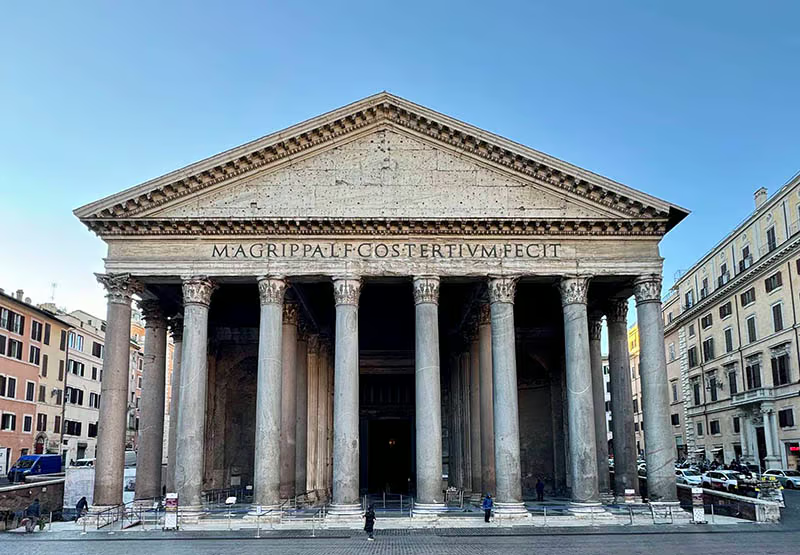
The Pantheon is the best-preserved ancient building in Rome and one of the most extraordinary architectural achievements in human history. It has stood continuously for nearly 1,900 years, has been an active Catholic church since 609 AD, and contains the tomb of Raphael. Since July 2023 it charges an entry fee. This guide covers how to skip the queue, how long to spend, what to wear, the best time to visit, and everything worth seeing inside.
What Is the Pantheon?
The Pantheon was originally built between 27 and 25 BCE by Marcus Agrippa, then completely rebuilt by Emperor Hadrian between 118 and 128 AD. The building you visit today is almost entirely Hadrian’s structure. Its official name as a church is Santa Maria ad Martyres, after Pope Boniface IV converted it from a Roman temple in 609 AD. That conversion is the primary reason it survived intact while almost every other ancient Roman building was stripped for materials.
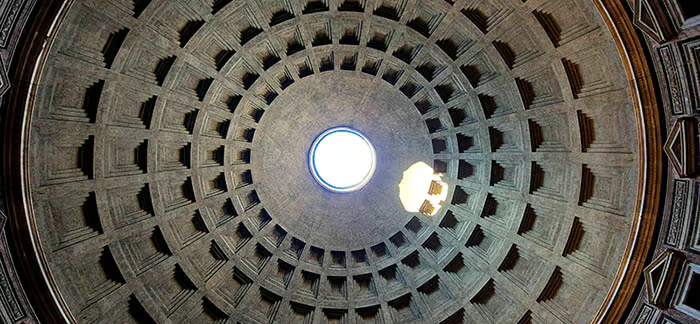
The engineering achievement at the center of the building is the dome: 43 metres in diameter and 43 metres from floor to oculus, forming a perfect sphere that would sit exactly inside the structure. The 9-metre circular opening at the top, the oculus, is the building’s only source of natural light and the detail that defines the entire experience of being inside. The dome remained the largest in the world for over 1,300 years until Brunelleschi built the Florentine Duomo in the 15th century.
Entry was free until July 2023. A mandatory €5 adult ticket has applied since then.
How Do I Skip the Line at the Pantheon?
This is the most important practical question about the Pantheon and the one most visitors do not research until they are already standing in the wrong queue.
Which Queue for the Pantheon?
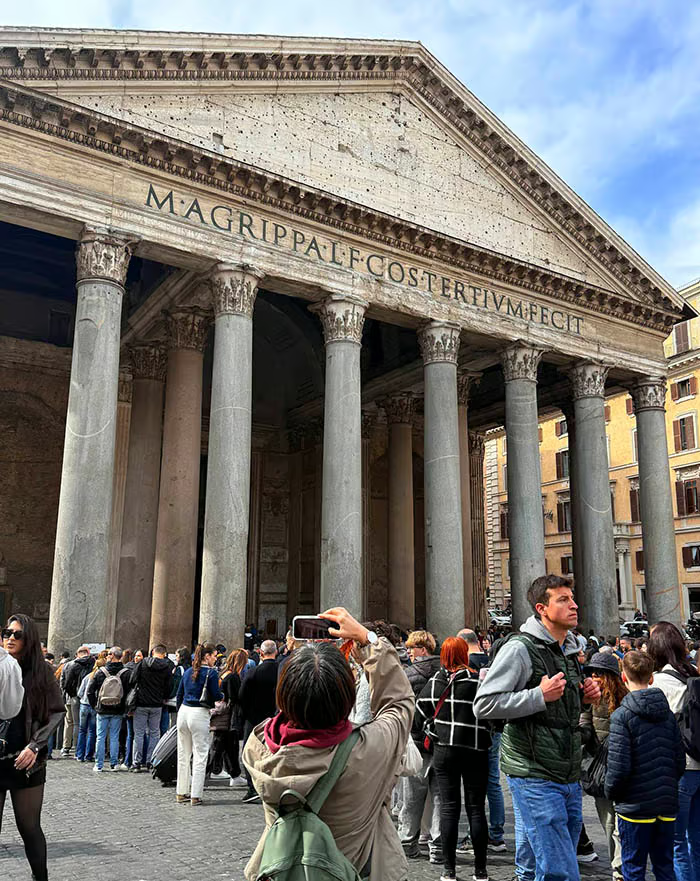
When you arrive at Piazza della Rotonda you will see two separate queues:
- Queue 1 (pre-booked tickets): A shorter, faster-moving lane for visitors who have already purchased their ticket online. This is the queue you want to be in. Wait time: typically 10 to 20 minutes even in peak season.
- Queue 2 (on-site purchase): The general queue for visitors buying tickets at the door. This queue moves significantly slower. Wait time: 30 to 60 minutes during peak season (April to October), occasionally longer on weekends and holidays.
The two queues are clearly separated but signage can be confusing. If you have a pre-booked ticket, look for the dedicated pre-booked lane and join it immediately. Do not follow the general crowd toward the main queue if you have already bought your ticket.
Your QR code is scanned directly from your phone screen. No printing is required.
How Long Is the Line for the Pantheon?
Without a pre-booked ticket, expect a wait of 30 to 60 minutes during peak season at any time between 10 AM and 3 PM. On busy spring and summer weekends the queue can extend to 75 minutes or more. With a pre-booked ticket, the wait drops to 10 to 20 minutes in almost all conditions.
The calculation is simple: a pre-booked ticket costs €5. An on-site ticket costs €5. The only variable is time. Pre-booking is always worth it. Book your Pantheon Priority ticket here
Can You Just Walk Into the Pantheon in Rome?
No, not since July 2023. Until that date the Pantheon was free to enter with no ticket required. The introduction of the mandatory €5 ticket changed that. All visitors now require a ticket, purchased either online in advance or on-site at the entrance.
The official booking portal is museiitaliani.it/acquista-biglietto. Tickets can also be purchased through third-party platforms, usually from €5. Guided tours include a separate entry allocation and often have availability when the standard ticket queue is long.
Book your Pantheon Priority ticket here
How Long Should You Spend at the Pantheon?
the Pantheon has no enforced time limit. You are not asked to leave after two hours. You can stay as long as you wish during opening hours. A typical tourist visit lasts 20 to 40 minutes. One hour is recommended if you want to experience the space properly: to sit and watch how the light from the oculus moves across the dome and floor, to stand in front of Raphael’s tomb without being immediately pushed along by a crowd behind you, and to walk the full perimeter reading each of the seven niches.
The building is a single circular space. It is not a multi-room museum requiring a route and a plan. What rewards slow looking here is the geometry and the light, both of which require patience to fully appreciate.
Is It Better to Visit the Pantheon Day or Night?
Day only. The Pantheon closes at 7:00 PM (last entry 6:30 PM) and is not open at night. However, the time of day within opening hours matters considerably.
Best time to visit:
- 9:00 AM opening slot: The quietest moment of the day. Crowds build quickly after 10 AM. Arriving at 9 AM gives you 30 to 45 minutes before the space becomes noticeably busier.
- Late afternoon (4:30 to 6:00 PM): Crowds thin out compared to midday, and the lower angle of the sun creates a softer, more atmospheric light through the oculus.
- Avoid 10 AM to 2 PM if possible, particularly on weekends. This is consistently the most crowded window of the day.
The oculus light beam: Around midday on sunny days, the sunlight enters the oculus as a defined circular beam and projects onto the dome interior and walls as it moves. This effect is most dramatic in spring and summer when the sun is high enough for the beam to be clearly defined. It is worth timing your visit to be inside at noon if this interests you.
Rain: Rain falls through the oculus onto the original Roman marble floor and drains through the central drain. The floor slopes almost imperceptibly toward the center to direct water to the drain. A rainy visit creates a vertical column of falling water inside the building, which is a genuinely extraordinary thing to witness and not at all a reason to avoid visiting in wet weather.
Is It Worth Going Inside the Pantheon in Rome?
Yes, without question. The introduction of the €5 fee prompted considerable complaint in 2023, but the interior of the Pantheon is one of the most architecturally overwhelming experiences in Rome. No photograph, however good, communicates the scale of the dome when you are standing directly beneath the oculus looking upward. The coffered concrete ceiling panels reduce in size progressively as they approach the opening at the top, creating a forced perspective that makes the dome appear even larger than it is. The building is 1,900 years old and the ceiling above you has not been reconstructed. You are looking at the original Roman concrete.
What to Wear to the Pantheon Rome
The Pantheon is an active Catholic church with an enforced dress code at the door. The rules are simple:
- Cover your shoulders. A T-shirt is enough. A light scarf over bare shoulders also works.
- Remove hats inside. This is a religious requirement, not optional.
- No very short shorts. Standard walking shorts that cover the mid-thigh are fine. This is more relaxed than the Vatican, where shorts of any length are refused.
- Sandals and flip-flops are allowed. The marble floor near the drain can be slippery when wet, so be aware of that.
- Bags are permitted. There is no size restriction like Galleria Borghese’s 40x40cm rule. Very large wheeled luggage may be turned away but standard tourist bags are never a problem.
If you are combining the Pantheon with the Vatican on the same day, dress for the Vatican (no shorts at all) and the Pantheon will not be an issue.
What to See Inside the Pantheon
The oculus and dome: Stand at the center of the floor directly below the oculus and look up. The coffered ceiling panels, 140 in a 5-tier ring, reduce progressively in size toward the opening, creating a perspective effect that makes the dome appear larger than it is. The dome is cast concrete, the original Roman mix, unreinforced and still structurally intact after nearly 1,900 years.
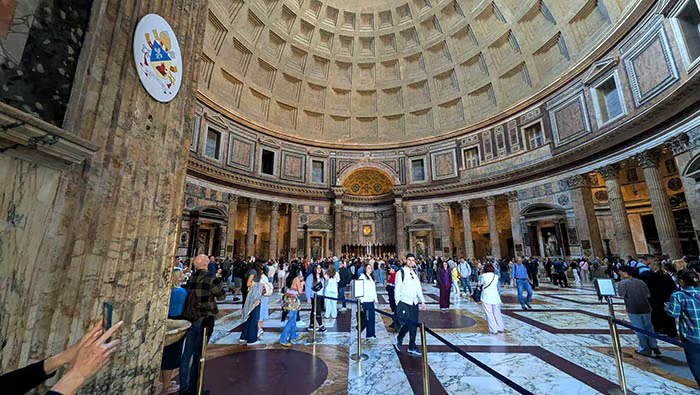
The marble floor: The geometric pattern of the floor is original Roman work from the 2nd century AD. The floor slopes almost imperceptibly (about 30 cm across the full diameter) toward the central drain. When it rains through the oculus the drain still works exactly as designed.
Tomb of Raphael: Ground level on the right side as you face the main altar. A simple sarcophagus set into the wall, marked by a plaque reading Ille hic est Raphael (Here lies Raphael). Above the tomb is a marble bust and a Madonna sculpture commissioned by his student Lorenzetto. Raphael died in 1520 at the age of 37 and specifically requested burial here.
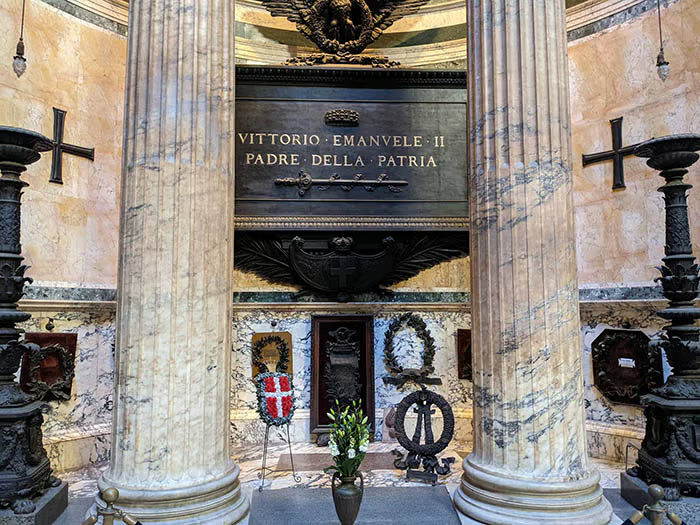
Tomb of Victor Emmanuel II: The first king of unified Italy, buried in a niche on the left side of the main entrance. The monument is flanked by an eternal flame maintained by veterans’ associations. Don’t miss Victor Emmanuel II Monument which is free for panoramic views and history!
The 16 granite columns of the portico: Each column stands 12 metres tall, weighs approximately 60 tonnes, and was quarried in Aswan, Egypt, then transported by sea to Rome. They are monolithic: each column is a single piece of stone, not drums stacked on top of each other.
The seven niches: The circular wall contains seven alternating rectangular and semicircular niches housing altars, tombs, and sculptural decoration. The marble veneer covering the walls is not original: much of the original bronze decoration was stripped over the centuries, most notoriously by Pope Urban VIII Barberini in the 17th century to cast cannon for Castel Sant’Angelo.
Tickets and Prices
| Visitor type | Price |
|---|---|
| Adult | €5 |
| EU citizens under 18 | Free |
| Non-EU children (under 6) | Free |
Tickets are available at the entrance or online via museiitaliani.it/acquista-biglietto. There is no significant price difference between the official site and most third-party platforms at the base ticket level, but third-party skip-the-line options often include priority queue access that justifies a small additional fee in peak season.
Opening hours:
- Monday to Saturday: 9:00 AM to 7:00 PM (last entry 6:30 PM)
- Sunday: 9:00 AM to 6:00 PM (last entry 5:30 PM)
- Closed: 1 January, 25 December, Easter Sunday morning (during Mass)
Getting There
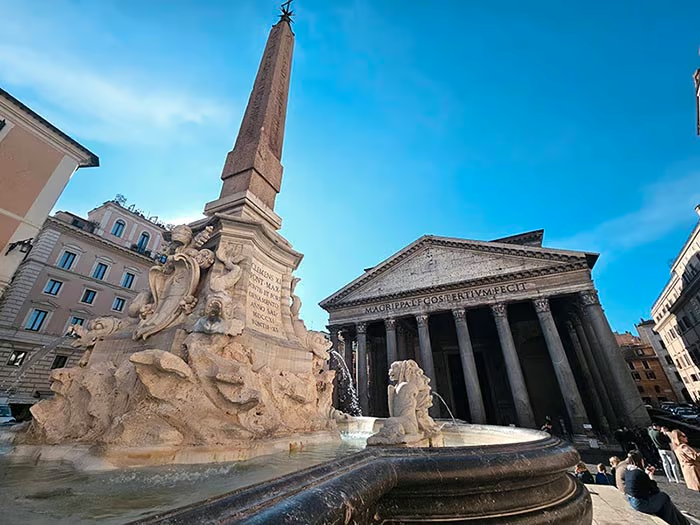
Address: Piazza della Rotonda, Rome.
The Pantheon sits in the heart of the historic center. There is no Metro stop within close walking distance:
- From the Trevi Fountain: 10 minutes on foot walking west.
- From Piazza Navona: 5 minutes on foot walking east.
- From Campo de’ Fiori: 10 minutes on foot walking northeast.
- From the Spanish Steps (Metro Spagna): 20 to 25 minutes on foot walking south through the centro storico.
- By bus: Lines 40, 64, and 87 stop near Largo Argentina, a 5-minute walk south of the Pantheon.
The entire surrounding neighborhood (rione della Pigna) is one of the most walkable in Rome. Almost any combination of central Rome sightseeing routes passes within a few minutes of the Pantheon.
FAQ: Pantheon Rome
The policy has been inconsistently enforced over recent years. Sealed bottles are generally tolerated in bags but drinking inside the building is not appropriate in an active church and should be avoided. Leave your bottle in your bag and drink before entering or after leaving.
The Pantheon is crowded year-round but the most difficult periods are July and August (extreme heat and maximum tourist volume), Holy Week and Easter (the church holds services and access is restricted during Mass), and summer weekends between 10 AM and 2 PM. The quietest period overall is November to early February on weekday mornings.
Yes. Non-flash photography is permitted throughout the building during normal visiting hours. Photography is not permitted during Mass services, which take place on Sundays and religious holidays at specific hours. Check for current Mass times at the entrance before your visit.
The main entrance is at street level with no steps. The interior floor is flat and accessible. The piazza outside is cobbled and may be uneven in places. There are no lifts or accessible routes to any elevated section as the building is a single-level space. Overall accessibility is good by Roman monument standards.
Yes. Sandals and flip-flops are accepted. Exercise care near the central drain area of the floor when the marble is wet.
No. Entry costs €5 for most visitors since July 2023, rising to €7 from 1 July 2026. Under-18s and Rome residents always enter free, and the first Sunday of each month is free for everyone. For the full breakdown of free days, who qualifies, and the 2026 first Sunday dates, see our dedicated guide: Is the Pantheon Free in Rome?