
Campo de’ Fiori is one of the most lived-in squares in Rome. In the morning it holds the city’s most famous open-air market. By evening it becomes one of the most popular aperitivo and nightlife squares in the historic center. There is no museum to queue for, no ticket to buy, and no reservation to make. You simply show up.
What Is Campo de’ Fiori Famous For?
Campo de’ Fiori is famous for two things that have nothing to do with each other: a daily flower and food market in the morning, and one of the most active bar and nightlife scenes in central Rome after dark. The square handles both without conflict because they occupy completely different hours of the day.
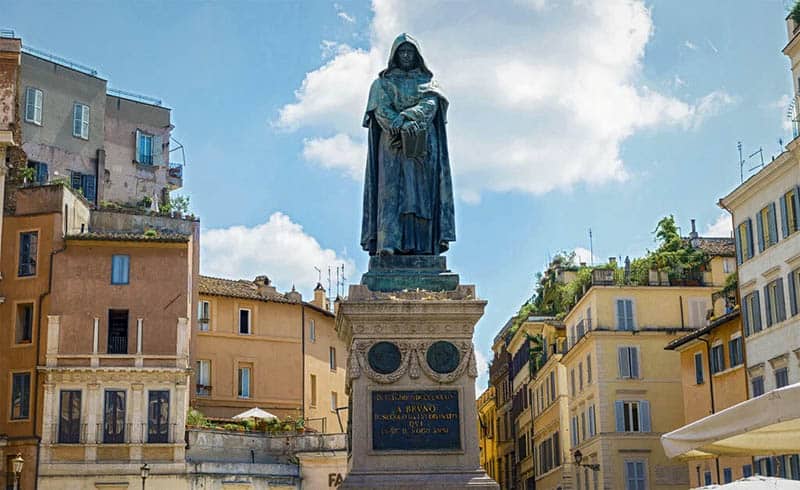
The hooded figure at the center of the square is Giordano Bruno, a Dominican friar, philosopher, and early astronomer who was burned at the stake on this exact spot in 1600 by order of the Inquisition for heresy. His statue, erected in 1889, faces toward the Vatican. It is one of the most charged pieces of public sculpture in Rome: a man executed for ideas that science later proved correct, staring permanently at the institution that killed him.
The name Campo de’ Fiori means “field of flowers” in Italian, a reference to the open meadow the square was before it was developed in the 15th century. It has no ancient Roman monuments beneath it, no church on its perimeter, and no Baroque fountains. What it has is atmosphere, and it has that in abundance.
What to Do in Campo de’ Fiori Rome
The Morning Market
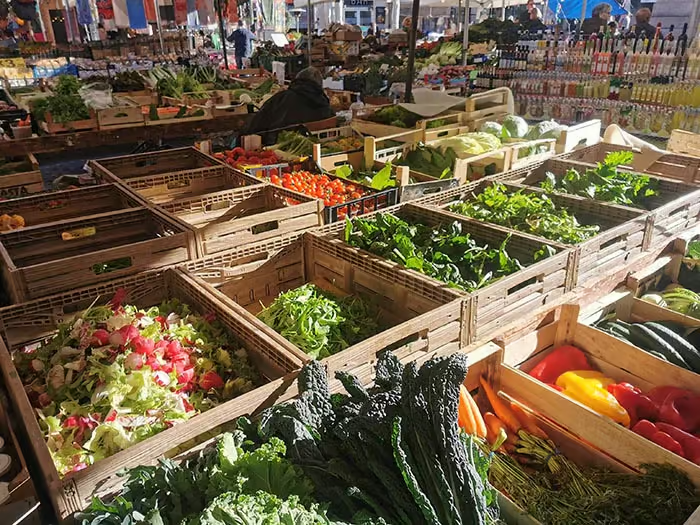
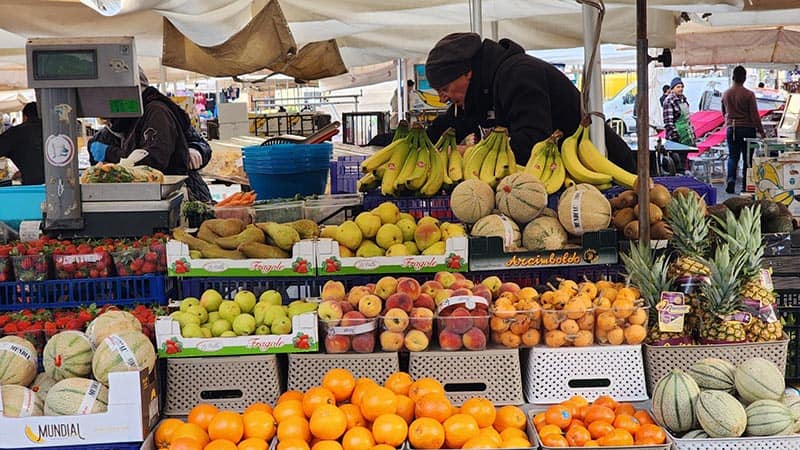
The market runs Monday to Saturday from approximately 7:00 AM to 4:00 PM. Sunday is the one day the square is marketless and noticeably quieter. The stalls sell fresh fruit and vegetables, flowers, dried herbs and spices, cheese, cured meats, and the kind of highly specific Italian kitchen equipment that Romans actually use. It is not a tourist market. Romans shop here. Prices are good, the quality is high, and the atmosphere in the early hours before the tourist crowd arrives is one of the most genuinely Roman experiences you can have in the historic center.
What to buy: fresh seasonal fruit, local chili varieties, truffle products, dried porcini, fresh pasta from the deli stalls, and cut flowers if you have somewhere to take them.

A 2.5-hour small-group street food walk through Campo de’ Fiori and Trastevere, with tastings of pizza, supplì, cured meats, and gelato led by a local foodie guide.
Book a Campo de’ Fiori food market tour here
The Evening Aperitivo and Nightlife
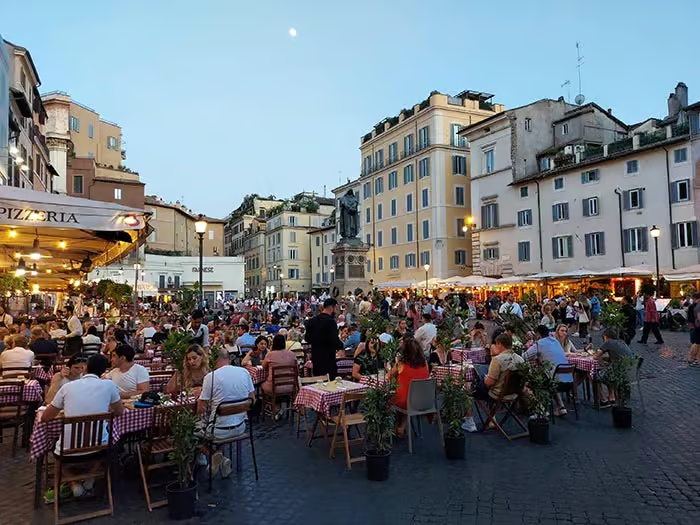
By late afternoon the market stalls are gone, the square is swept, and the bars and restaurants surrounding the piazza set out their tables. Campo de’ Fiori is one of the most concentrated aperitivo and evening drinking areas in Rome, particularly popular with younger travelers and students from the nearby universities. The energy is loud, sociable, and entirely different from the morning version of the same square. If you want to understand why Romans call this square a place with two personalities, the most effective way is to visit it twice: once at 8 AM and once at 8 PM.
One important note: the restaurants and bars directly on the square are priced at tourist rates. For a better aperitivo at a better price, walk one block in any direction into the surrounding streets of the Regola and Parione neighborhoods.
Is Campo de’ Fiori Worth Visiting
Yes, particularly if you are in Rome for more than two days and want an experience that is not organized around a monument. Campo de’ Fiori does not ask anything of you. You do not need to pre-book, dress a certain way, or follow a route. The market rewards slow wandering. The Giordano Bruno statue rewards a moment of thought. The surrounding streets, which include some of Rome’s best independent food shops, delis, and wine bars, reward a detour.
It is not a replacement for the Pantheon or Piazza Navona. It is a complement to them. The square works best as part of a historic center walking morning: Campo de’ Fiori for the market, then 5 minutes north to Piazza Navona, then 10 minutes northeast to the Pantheon.
Tours That Cover Campo de’ Fiori
A guide adds what a solo visit cannot: the Giordano Bruno story told properly, the market history, and the neighborhood connections most visitors miss.
Three options worth knowing about:
On a budget: free tours (tip-based)
Several operators run tip-based historic center walks that pass through Campo de’ Fiori alongside Piazza Navona and the Pantheon. You pay nothing upfront and tip at the end (€10 to €20 is standard). New Rome Free Tour and Guru Walk both run daily departures.
Join a free tour (tip-based) that covers Campo de’ Fiori
For food lovers: the market and food tour
A morning walk starting at Campo de’ Fiori, through the Jewish Ghetto and into Trastevere, with tastings along the way. From around €35 to €80 per person, weekday mornings only.
Browse food tour that might include the market in Campo de’ Fiori
For a full historic center morning: walking tour or E-bike
A small-group route combining Campo de’ Fiori, Piazza Navona, and the Pantheon (ticket included) in two to three hours. The best day-one orientation in Rome
Join the tour and enjoy the underrated attractions of Rome
If you’re looking for E-bike tour that covers most of the important piazzas and attractions of Rome – Join the tour here
What Is the Best Time to Go to Campo de’ Fiori?
Day or Night?
Both, for different reasons. The morning market (7 AM to 4 PM) is the primary reason most visitors come. Arriving before 9 AM gives you the market at its fullest and the square at its least crowded. After 11 AM the tourist volume builds and the shopping experience becomes noisier and more congested.
The evening aperitivo scene (from around 6 PM onward) is worth experiencing if you want the social and atmospheric side of the square. Friday and Saturday evenings are the busiest and loudest. Weekday evenings are more relaxed.
Getting to Campo de’ Fiori
The square sits in the heart of the historic center with no direct Metro connection. The closest Metro stop is Barberini on Line A, a 25-minute walk. In practice everyone arrives on foot:
- From Piazza Navona: 5 minutes on foot walking south. See our Piazza Navona Rome guide.
- From the Pantheon: 10 minutes on foot walking southwest. See our Pantheon Rome guide.
- From Trastevere: 10 minutes on foot crossing the Tiber at Ponte Sisto.
- By bus: Lines 40, 64, and 116 stop near Largo Argentina, a 5-minute walk east.
Travelers get the best from Campo de’ Fiori Rome by following these handy suggestions for a memorable outing.
Shop from 7 AM to 4 PM Monday through Saturday for fresh goods and local vibes. Arrive early for the best selection of produce and flowers. (prices are high and for tourists)
Mornings capture the authentic market bustle; evenings bring aperitivo crowds. Avoid Sundays when the market closes
FAQ: Campo de’ Fiori Rome
Monday to Saturday, approximately 7:00 AM to 4:00 PM. The market does not run on Sundays.
“Field of flowers.” The name refers to the open meadow that occupied the site before the square was developed in the 15th century.
Yes. The square is public and free at all hours. The market stalls sell goods at normal market prices. There is no entry fee, no ticket, and no reservation for anything in the square itself.
Giordano Bruno, a philosopher and early astronomer burned at the stake on this spot by the Inquisition in 1600. The statue was erected in 1889 and faces toward the Vatican.
Yes. The square is flat and fully paved. The surrounding streets are cobblestone and uneven in places but the piazza itself is easily navigable.
As Rome’s only monumental square without one, it developed as a market and execution area rather than a religious center.