
The Fountain of the Four Rivers – Fontana dei Quattro Fiumi, also searched as the fiumi fountain Rome – is the centrepiece of Piazza Navona and one of the greatest Baroque sculptures created by Gian Lorenzo Bernini. Completed in 1651 on the commission of Pope Innocent X, the four giant river gods represent the four continents then known to Europe, each encoded with a precise political and theological message from the 17th-century Catholic Church. Standing 30 metres tall with an Egyptian obelisk at its peak, it is completely free to see in the open square of Piazza Navona with no entry fee or barriers. This guide explains everything you are actually looking at.
What Is the Most Famous Fountain in Rome?
By sheer footfall and global name recognition, the Trevi Fountain holds that title. But by artistic complexity and density of meaning, the Fontana dei Quattro Fiumi makes a stronger case. The Trevi is a grand theatrical backdrop. This fountain is a sculpture you can read.
What is Rome’s most ornate fountain?
The Rome Four Rivers Fountain is almost certainly Rome’s most densely encoded public sculpture. Consider what is packed into it: four river gods, each carved by a different sculptor under Bernini’s direction; a genuine Egyptian obelisk standing 16.5 metres tall; a dove at the summit carrying an olive branch; a pile of coins beneath the Rio de la Plata figure; a long oar held by the Ganges; a veil covering the Nile’s face; the papal coat of arms on the Danube figure; travertine rock formations suggesting the natural world; and a complete theological programme connecting water, the four continents, and divine grace. Nothing here is decorative for its own sake. Every element carries a meaning.
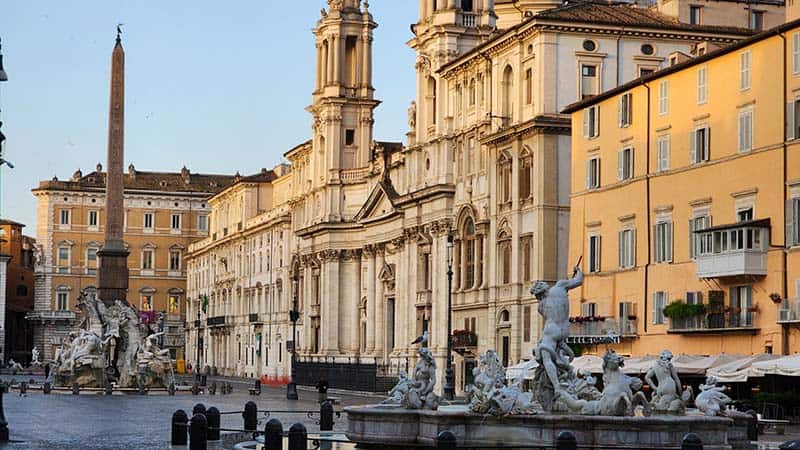
Piazza Navona has three fountains arranged along its central axis. The Fountain of the Four Rivers sits at the centre and is by far the largest. The Fountain of the Moor (Fontana del Moro) anchors the southern end. The Fountain of Neptune (Fontana del Nettuno) anchors the northern end. All three are free to view and there are no barriers. For the full story of the square, see our Piazza Navona Rome guide.
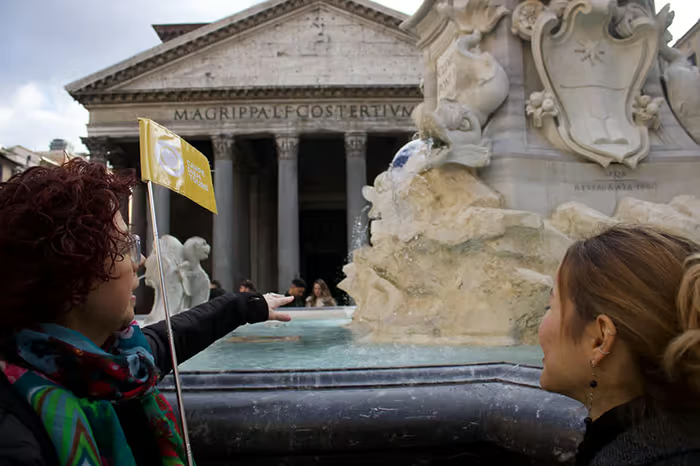
This two-hour walking tour covers the historic centre on foot, taking in six stops across the neighbourhood. The route runs from Piazza Venezia and Trajan’s Column through to the Trevi Fountain, the hidden interior of Galleria Sciarra, and the Church of Sant’Ignazio di Loyola with its famous trompe l’oeil ceiling. The tour passes by the Pantheon (exterior only) before finishing in Piazza Navona, steps from the Fountain of the Four Rivers. A guide leads every stop with dedicated time at each one, no rushing between sights.
What Does the Fountain of the Four Rivers Symbolize?
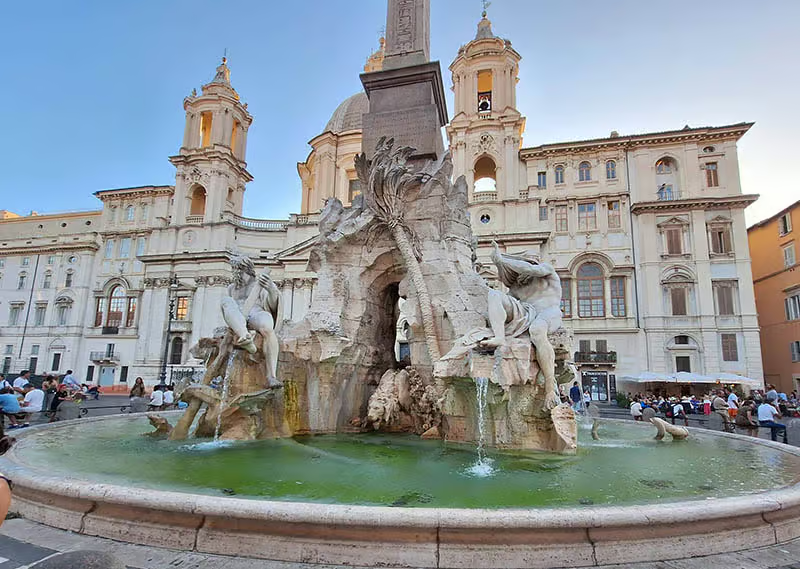
The fountain is not just a decorative centrepiece. It is a political and theological statement commissioned by one of the most image-conscious popes of the 17th century. Pope Innocent X Pamphilj wanted the fountain to communicate a single idea: that the Catholic Church, under his papacy, had dominion over the entire known world. Water in Baroque Catholic theology carried a specific meaning: divine grace flowing outward from Rome to all corners of creation. The four river gods are the literal embodiment of that claim.
What does each river god represent?
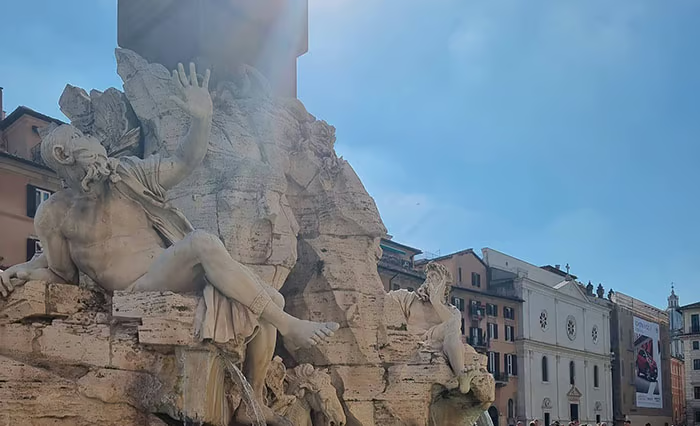
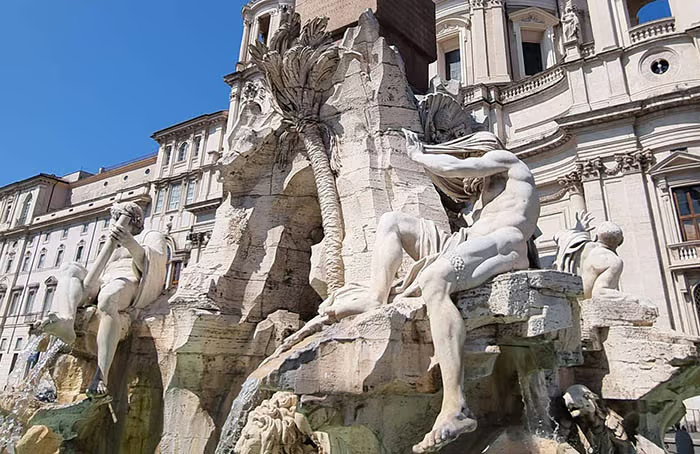
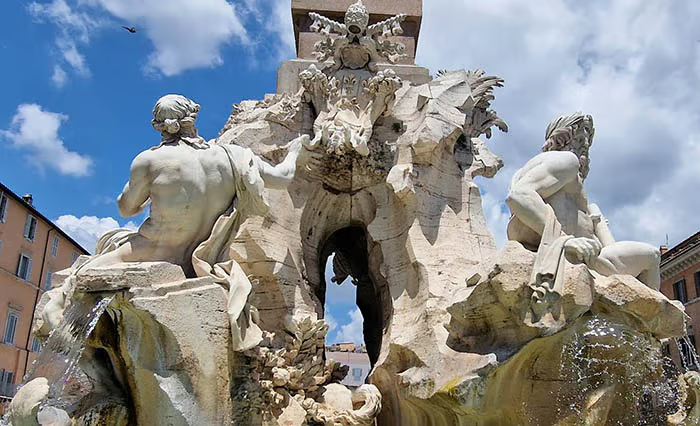
Each figure was designed by Bernini but carved by a specialist sculptor working under his supervision. The table below covers who made each figure, what it holds, and what that detail means.
| River god | Key detail | Meaning |
|---|---|---|
| Nile (Africa) | Veiled face | Source of the Nile was unknown in 1651 |
| Ganges (Asia) | Long oar | Vast navigable length across a continent |
| Danube (Europe) | Papal coat of arms | Europe as the seat of Catholic power |
| Rio de la Plata (Americas) | Pile of coins | Plata = silver, wealth of the New World |
Do the four rivers represent biblical rivers?
The short answer is no. The Nile, Ganges, Danube, and Rio de la Plata are not the four rivers of Eden described in Genesis (Pishon, Gihon, Tigris, Euphrates). However, Bernini almost certainly borrowed the symbolic resonance of that biblical image deliberately. The four rivers of Eden were understood in Christian theology as the source of grace flowing outward to nourish the whole world. By mapping that structure onto the four known continents, Bernini and Innocent X were making a parallel claim: Rome is the new Eden, and the Church is the source from which grace flows to all humanity.
The obelisk is Roman-era, not pharaonic. It was carved in Egypt and brought to Rome in the 1st century AD, originally erected for the Serapeum of Domitian in 81 AD. By the 17th century it had fallen and was found in five broken pieces at the Circus of Maxentius on the Appian Way. Bernini had the fragments reassembled in 1649 and raised them as the fountain’s centrepiece. The dove at its tip is the symbol of the Holy Spirit and simultaneously the personal emblem of the Pamphilj family, making it a theological and dynastic statement in one.
When Was the Fountain of the Four Rivers Made?
Construction ran from 1648 to 1651, with the fountain unveiled in June 1651. The story of how Bernini got the commission, who actually carved the stone, and the famous rivalry myth that guides across Rome still repeat today, are all worth knowing before you stand in front of it.
What is the story behind the commission?
Pope Innocent X had no intention of giving the commission to Bernini. He preferred other artists and had deliberately excluded Bernini from major papal projects. Bernini knew this. He had a silver model of his design made and arranged for it to be placed where the pope would encounter it, reportedly through the mediation of Donna Olimpia, the pope’s influential sister-in-law. When Innocent X saw the model he was said to have stood before it for half an hour before finally awarding Bernini the commission. The total cost came to 29,000 scudi, partly funded through a tax on bread.
Who carved the Fountain of the Four Rivers?
Bernini designed the fountain in full but did not carve the major figures himself. Each river god went to a specialist sculptor working under his direct supervision: Giacomo Antonio Fancelli carved the Nile (1650), Antonio Raggi carved the Danube (1650), Claude Poussin carved the Ganges (1651), and Francesco Baratta carved the Rio de la Plata (1651). This was standard practice for large-scale Baroque commissions. Bernini conceived the programme and controlled the result. The unity of the finished fountain across four different hands is a measure of how tightly he ran the project.
The Bernini vs Borromini rivalry: myth or fact?
The story told by almost every guide in Piazza Navona goes like this: the Rio de la Plata figure raises its arm toward the church of Sant’Agnese in Agone on the western side of the square, shielding its eyes in mock horror at the facade. The Nile covers its face for the same reason. Both are Bernini’s jokes at Borromini’s expense, mocking his church before it was even finished.
It is a wonderful story. It is also impossible.
The Fountain of the Four Rivers was unveiled in June 1651. Construction on Sant’Agnese in Agone did not begin until 1652, a full year later, and Borromini did not take over the facade until 1653. Bernini could not have designed figures to mock a building that did not yet exist. The covered face of the Nile refers to the unknown source of the river. The raised arm of the Rio de la Plata is a compositional device to create visual dynamism and balance. The rivalry between the two men was real and bitter. This particular story was invented afterwards, and tour guides keep telling it because it is a better story than the truth.
Visiting the Fountain of the Four Rivers
The Fontana dei Quattro Fiumi sits at the centre of Piazza Navona, an open public square with no admission fee and no barriers. There is nothing to book and nothing to pay. What you do need is a single piece of practical advice: walk the full perimeter of the basin. All four river gods face outward in different directions and you cannot see the fountain properly from one position.
How tall is it and is it free?
The 4 river fountain Rome visitors most often photograph rises 30 metres from basin to obelisk tip, with the obelisk alone standing 16.5 metres and from the very tip of the obelisk to ground level the full height reaches around 35 metres. A common question asks about its depth: the basin is shallow, around 60 centimetres, and the visual scale comes entirely from height, not depth. Entry is free, the square is open 24 hours, and there are no timed slots. The best times to visit are 9 AM before the crowds arrive or in the evening when the fountain is floodlit. Avoid 11 AM to 2 PM in summer.
If you are planning to visit the Trevi Fountain, which is a 15-minute walk east of Piazza Navona, note that a €2 entry ticket has been required there since February 2026. Trevi Fountain Rome guide
Directly beneath Piazza Navona lies the 2,000-year-old Stadium of Domitian, the ancient athletics arena whose oval footprint determined the shape of the square above it. Tickets are €10, and the visit takes around 40 to 60 minutes. Stadium of Domitian Rome
Want to see Piazza Navona, the Fountain of the Four Rivers, and the surrounding historic centre with a local guide at no fixed cost? This free walking tour covers the heart of Rome on foot, with Piazza Navona as one of its main stops. It runs on a tips-based model: you pay what you think it was worth at the end. No booking fee, no minimum.
Join the free Rome historic centre walking tour
FAQ: Fountain of the Four Rivers Rome
Each river god represents one of the four continents as known to 17th-century Europe: the Nile for Africa, the Ganges for Asia, the Danube for Europe, and the Rio de la Plata for the Americas. Together they express Pope Innocent X’s claim that the Catholic Church held dominion over the entire known world.
The source of the Nile was unknown in 1651. Bernini covered the figure’s face as a direct reference to that unsolved geographic mystery: the river’s origin remained hidden from human knowledge.
The obelisk is a Roman-era Egyptian obelisk originally erected in 81 AD for the Serapeum of Domitian. It was found in five broken pieces at the Circus of Maxentius on the Appian Way, reassembled in 1649, and raised on top of the fountain as its centrepiece. It stands 16.5 metres tall.
No. The fountain was unveiled in June 1651. Construction on Sant’Agnese in Agone did not begin until 1652 and Borromini did not take over the facade until 1653. The gestures of the figures have independent explanations. The rivalry between the two men was real; the story is a later invention.
Yes, completely. Piazza Navona is an open public square with no entry controls, accessible 24 hours a day with no ticket required.
Pope Innocent X Pamphilj, who awarded Bernini the commission after encountering his silver model. Construction ran from 1648 to 1651 and the fountain was unveiled in June 1651.