
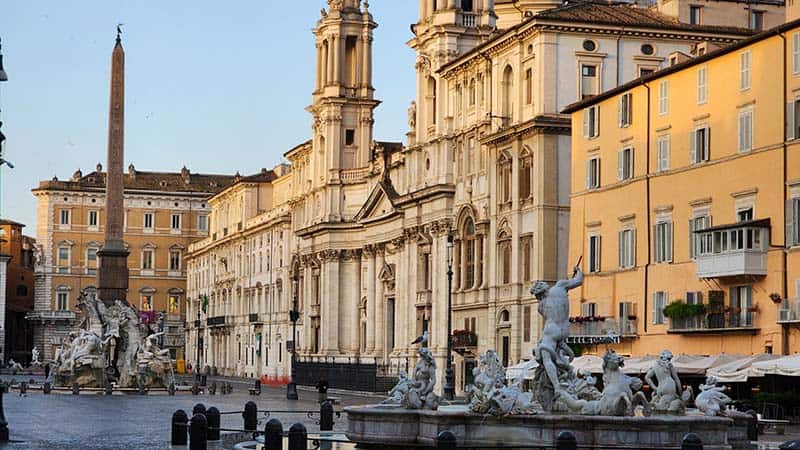
Piazza Navona is the most beautiful Baroque square in Rome and one of the few truly unmissable stops in the historic center that costs nothing to visit. The square is free, the fountains are free, the church is free, and you can walk through at any hour of the day or night. This guide covers what to see, how long to spend, when to go, and the one paid experience worth adding.
Yes, completely. Piazza Navona is a public square, open 24 hours a day, 7 days a week, with no entry fee, no ticket, and no reservation required. You can walk in, stay as long as you like, and leave without spending a euro.
| What | Cost |
|---|---|
| The square and all outdoor areas | Free, always |
| The three fountains | Free |
| Sant’Agnese in Agone church | Free |
| Stadium of Domitian underground ruins | €9, pre-booking available |
| Museo di Roma (Palazzo Braschi) | €8 |
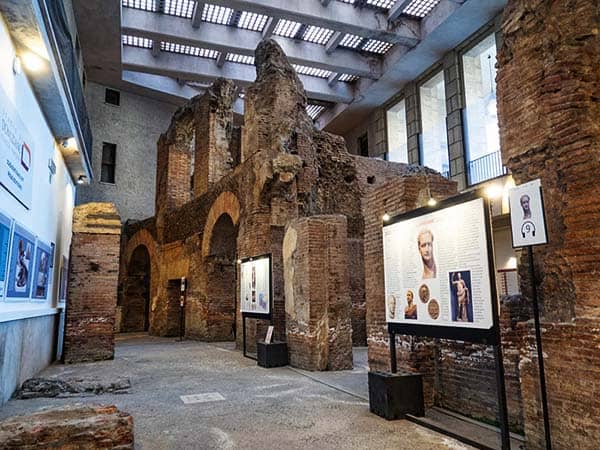
The only paid experience directly connected to the square is the underground archaeological site beneath it, the ruins of the ancient stadium the piazza was built on. It is worth adding if you have an hour and an interest in what is under your feet.
Beneath the modern square, remains of the Stadium of Domitian lie 5-6 meters underground and can be visited for €10, with tours lasting 40 minutes. Palazzo Braschi hosts the Museo di Roma, displaying paintings and artifacts chronicling the city’s evolution through centuries.
The Fountain of the Four Rivers
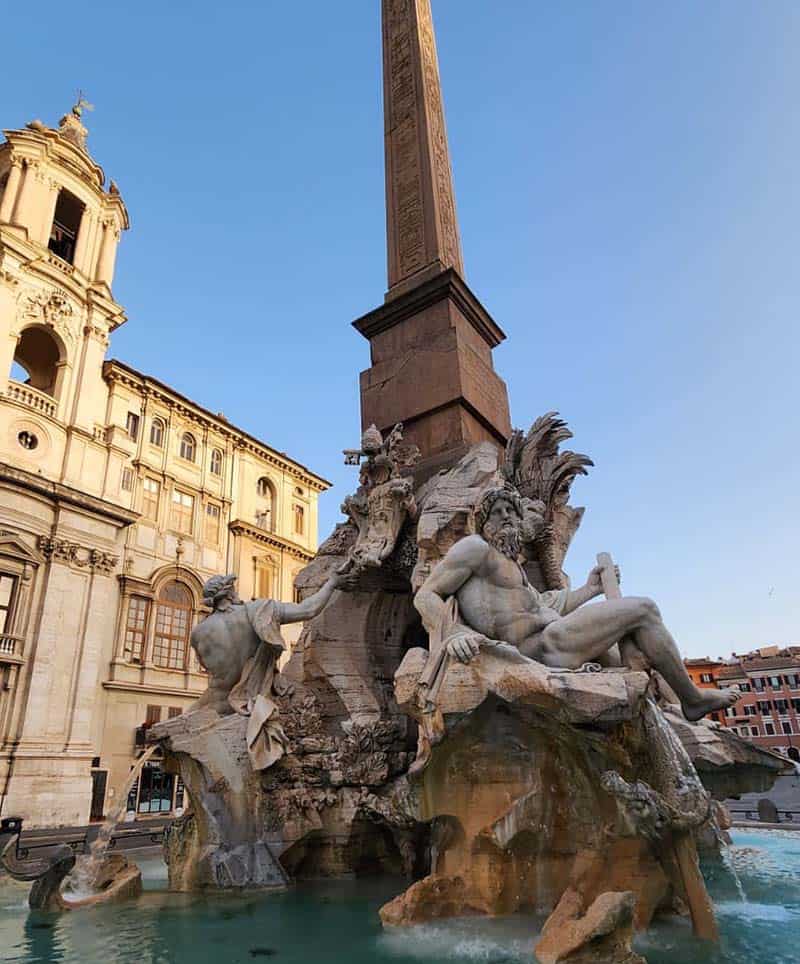
The Fountain of the Four Rivers (Fontana dei Quattro Fiumi) is the centerpiece of the square and one of the greatest works of Baroque sculpture anywhere in Rome. Bernini designed it in 1651 for Pope Innocent X. Four colossal marble figures represent the four great rivers of the known world: the Nile (Africa), the Ganges (Asia), the Danube (Europe), and the Rio de la Plata (Americas). Each figure symbolizes one continent. Above them, rising from a mass of carved travertine rock, stands a genuine Egyptian obelisk crowned by a dove, the emblem of the Pamphili family who commissioned it.
The figure of the Nile has its head veiled: the source of the Nile was unknown at the time and Bernini used the veil to represent that mystery. The Rio de la Plata raises one arm as if shielding its eyes, a gesture that popular legend claims was directed at the facade of Sant’Agnese in Agone across the square, designed by Bernini’s rival Borromini, as if horrified by the sight of it. The timeline makes this story impossible: the church facade was completed after the fountain. But the legend is old, well-loved, and told by every guide who stands in front of the fountain.
The obelisk rising from the center of the fountain is a genuine ancient Egyptian original, not a Roman copy. It was created for Emperor Domitian, stood for centuries at the Circus of Maxentius on the Appian Way, and was moved here by Pope Innocent X in 1651 specifically for Bernini’s design.
The Other Two Fountains
Most visitors photograph the central fountain and miss the other two entirely. There are three fountains in Piazza Navona, not two as many guides suggest.
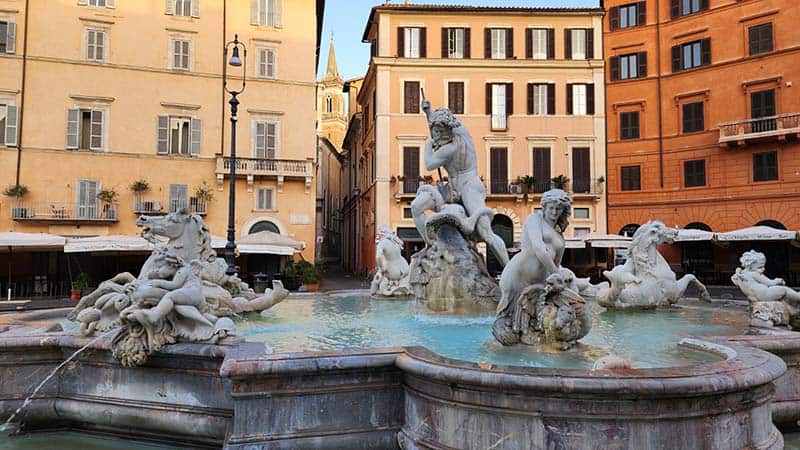
Fountain of Neptune (Fontana del Nettuno): At the northern end, showing Neptune fighting a sea creature surrounded by sea nymphs and cherubs. The sculptural group was added in 1878 to balance the Moor fountain visually. The basin itself dates back to the 16th century and was originally a plain water trough.
Of Rome’s three most celebrated fountains, the Trevi wins on scale and spectacle, but the Four Rivers fountain is considered the greater sculptural achievement by art historical consensus.
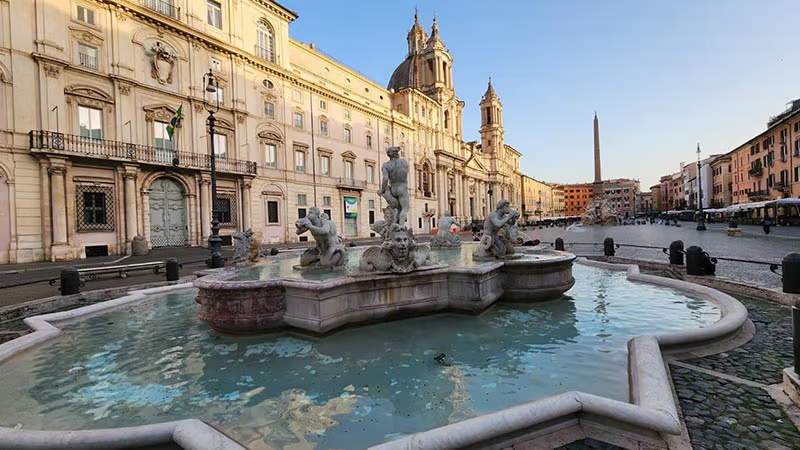
Fountain of the Moor (Fontana del Moro): At the southern end of the square. The central figure of a man wrestling a dolphin is sometimes attributed to Bernini himself, though the figure was reworked in the 17th century. The four Tritons around the basin were added later.
Sant’Agnese in Agone Church
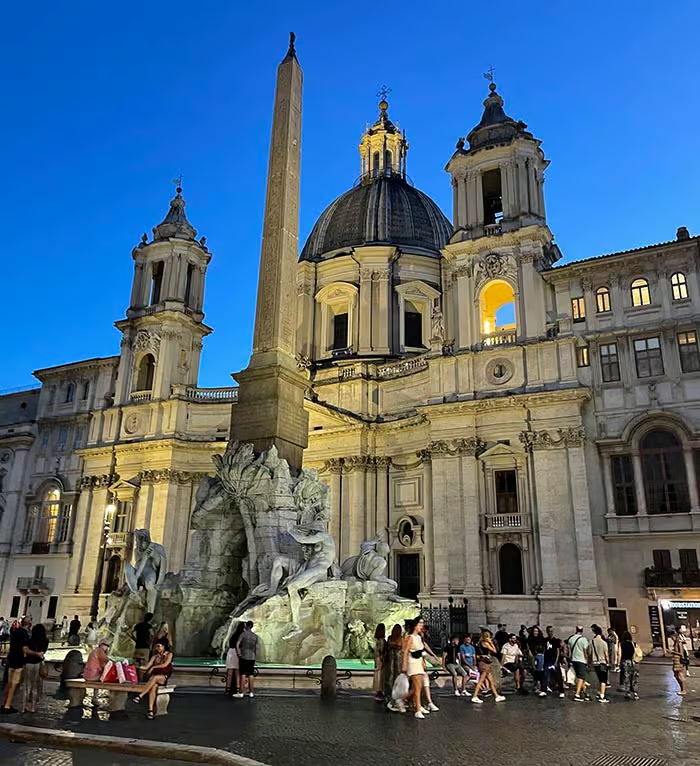
The church on the western side of the square, directly facing the central fountain, was redesigned by Francesco Borromini from 1653 onward for Pope Innocent X. Entry is free. The interior is small but richly decorated with polychrome marble, gilded stucco, and a series of altar chapels. The concave facade, one of Borromini’s most recognizable contributions to Roman Baroque architecture, is best appreciated from the fountain directly in front of it. The church is dedicated to the early Christian martyr Agnes, whose martyrdom according to tradition took place on this very site when it was still an ancient stadium.
The Stadium of Domitian Underground
Piazza Navona owes its elongated oval shape entirely to the Stadium of Domitian, the ancient Roman athletics stadium built in 86 AD that once occupied this space. The stadium held approximately 30,000 spectators. When it fell out of use, Romans built directly on top of it and the oval footprint was preserved in the shape of the streets and buildings around it.
The underground ruins are accessible through a dedicated entrance on the square. The site takes 45 to 60 minutes and includes original Roman walls, vaulted corridors, and an informative layout explaining how the stadium was constructed and used. Tickets cost from €9 can be pre-booked online.
Book a Piazza Navona guided walking tour here
Travelers enjoy Piazza Navona Rome fully by following these practical suggestions for an enriching experience.
- Best Time to Visit: Early morning offers peaceful exploration before crowds arrive; evenings bring magical lighting and street performers. December transforms it into a festive Christmas market with the Befana Festival.
- Getting There: Walk from Pantheon (5 minutes) or take buses to nearby stops; no metro station directly serves the piazza. Central location makes it perfect for combining with Campo de’ Fiori or Pantheon visits.
- What to See and Do: Admire Bernini’s fountains, tour the underground stadium ruins, visit Sant’Agnese church, and watch street artists perform. Enjoy gelato or coffee at surrounding cafes while soaking in the atmosphere.
- Entry and Tickets: The square is free and open 24/7; Stadium of Domitian tickets cost around €10, and Museo di Roma charges €8 (Tuesday to Sunday, 10 AM to 7 PM).
- Nearby Attractions: Explore Pantheon, Campo de’ Fiori market, or the Pasquino statue where Romans leave satirical notes about powerful figures.
- Practical Advice: Watch for pickpockets in crowds, check restaurant prices before sitting (tourist area premiums apply), and wear comfortable shoes for cobblestones.
For the square alone: 30 to 45 minutes is enough to walk the full perimeter, spend time at each fountain, look into the church, and absorb the space at a relaxed pace.
Adding the Stadium of Domitian: Allow 1.5 to 2 hours total.
Best time to visit: The square is at its quietest before 9 AM. Early morning offers the unusual experience of Piazza Navona almost empty, the fountains running, and no vendors, no queue, no crowds. It is a completely different place from the same square at noon.
Evening is the most atmospheric time. The fountains are lit from below after dark, the church facade glows, the cafe terraces are active, and the square takes on an entirely different character from its daytime version. The combination of Baroque architecture and ambient evening light makes it one of the most photographed night scenes in Rome.
Avoid: July and August midday hours are the most uncomfortable (peak heat and peak crowds combined). The Christmas market in December fills the square with market stalls from late November through early January, which changes the character of the piazza significantly. Some visitors love it. Others find it obstructs the fountains. Worth knowing before you arrive.
Yes, without qualification. It is free, central, and genuinely extraordinary. The Fountain of the Four Rivers alone is worth crossing the city for. The context of the stadium underneath it, the church opposite it, and the scale of the Baroque ensemble surrounding it make it one of the most concentrated examples of 17th century urban design surviving anywhere in Europe.
The square itself is not. The restaurants with their outdoor terraces directly on the piazza are. Eating or drinking on the square will cost you two to three times the price of the same item one or two streets away. Piazza Navona is one of the most aggressive tourist pricing zones in Rome. For coffee and food, walk one block in any direction and prices return to normal.
The street artists and portrait painters along the square edge are a long-standing tradition and entirely voluntary. No one will pressure you if you walk past without stopping.
Yes. Piazza Navona is one of the better-lit, more consistently populated squares in Rome at night. The combination of restaurant terraces, tourists, and locals in the area means the square itself is busy and well-observed until late. Normal urban awareness applies: keep your bag in front of you, do not leave valuables on café tables, and be aware of pickpockets in dense crowd moments. These are not Piazza Navona-specific issues; they apply to all of central Rome.
When to Avoid Rome in 2026?
For Piazza Navona specifically, the most difficult periods are July and August (maximum heat and maximum tourist density), Easter week (the historic center becomes extremely crowded, particularly around major religious sites), and summer weekends between 11 AM and 3 PM when the square reaches its daily crowd peak. If you are visiting in those periods, the 9 AM visit strategy remains the most reliable solution.
The name comes from the Latin in agone (the games), referring to the Stadium of Domitian on which the piazza was built. Spoken over centuries, in agone became navona.
Yes. It is a genuine ancient Egyptian obelisk originally created for Emperor Domitian, later moved to the square and placed on top of Bernini’s Fountain of the Four Rivers in 1651.
Yes. The square is flat and fully paved with no steps. The Stadium of Domitian underground requires stairs and has limited accessibility.
Yes, the square is free and accessible 24/7, though underground Stadium of Domitian tickets cost around €10 and museum entry (€8) require tickets.
Most notably Angels and Demons (2009), in which the Fountain of the Four Rivers is central to the plot.
The Fountain of the Four Rivers (center, Bernini, 1651), the Fountain of the Moor (south end), and the Fountain of Neptune (north end). All three are free to view.
No. They are two separate locations approximately 15 minutes apart on foot in different parts of the historic center.