
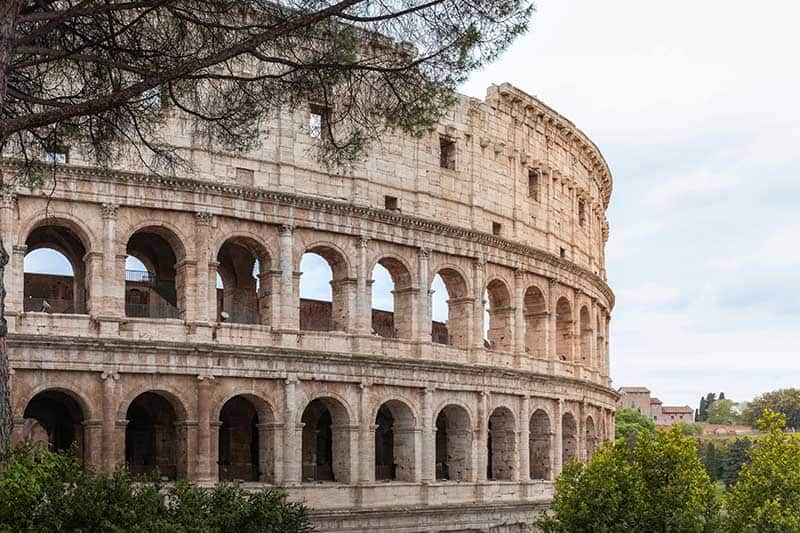
The Colosseum, the Roman Forum, and Palatine Hill are three separate archaeological sites covered by one combined ticket. Together they form the largest open-air ancient Roman complex in the world. Most visitors come for the Colosseum and rush through the other two. That is a mistake. All three are included in the same ticket, they connect on foot, and together they tell the complete story of ancient Rome. This guide covers every ticket type, the correct visit order, how long each site takes, and everything you need to know before you arrive. For a broader overview including what not to miss inside each site, see our complete Colosseum Rome guide.
Are the Roman Forum and Palatine Hill the Same Thing?
No. They are three separate archaeological sites that share one combined ticket and one entry gate for the Forum and Palatine. The Roman Forum is the ancient city center, a valley packed with temples, arches, and public monuments. Palatine Hill rises directly above the Forum to the south and was the residential district of Rome’s emperors. The Colosseum stands at the eastern end of the Forum valley, a five-minute walk along the Via Sacra.
Is Palatine Hill Connected to the Roman Forum?
Yes. Palatine Hill and the Roman Forum share the same entry gate and the same ticket. The path through the Forum leads naturally upward onto Palatine Hill with no additional queue or ticket check. Many visitors do not realise this and skip Palatine entirely, which is one of the most common missed opportunities at this site.
The Colosseum uses a separate physical entrance a short walk east. You present your ticket again at that gate. There is a strict no re-entry policy: once you exit any of the three sites you cannot return on the same ticket.
Is It Worth Going to the Roman Forum and Palatine Hill?
Yes. The Roman Forum is where ancient Rome actually happened: the Senate met here, emperors gave speeches here, and the Arch of Titus (the most historically significant monument in the complex) still stands at the eastern entrance. The Temple of Saturn, dedicated in 497 BCE, makes it one of the oldest surviving Roman structures in existence.
Palatine Hill is the most underrated of the three sites and the most frequently skipped. It is the mythological and archaeological birthplace of Rome, the hill where Romulus founded the city in 753 BCE. The ruins of the Domus Augustana, the imperial palace where Augustus and his successors lived for centuries, cover almost the entire hilltop. The panoramic view from the southern edge over the Circus Maximus is one of the finest in Rome and costs nothing extra.
Is It Worth It to Go to Palatine Hill?
Yes. Palatine Hill is included in your ticket at no extra cost. The imperial palace ruins are extensive, the hilltop gardens are shaded and peaceful, and the elevated views over the Forum on one side and the Circus Maximus on the other are genuinely impressive. It is also the least crowded of the three sites at almost any time of day.
Why Is Palatine Hill So Famous?
Palatine Hill is the mythological and archaeological origin of Rome itself. Archaeological excavations have found Iron Age hut foundations dating to the 8th century BCE that align with the traditional founding narrative. The Latin word for the hill, Palatium, is the direct origin of the English word palace. Every Roman emperor from Augustus onward built or expanded a palace complex here, leaving behind one of the most extensive imperial building programs in ancient history.
To understand the full history of the complex before your visit, read our guide to why the Colosseum was built.
Tickets: What You Need to Know
What Tickets Are Available?
The official Parco Archeologico del Colosseo offers several ticket types. These are the main options:
| Ticket type | What is included | Validity | Price (adult) |
|---|---|---|---|
| Standard | Colosseum (levels 1-2) + Roman Forum + Palatine Hill | 24 hours | €18 |
| Full Experience – Arena Floor | Standard + arena floor access | 2 days | €24 |
| Full Experience – Arena + Underground | Standard + arena floor + hypogeum | 2 days | €24 |
| Full Experience – Attic | Standard + 3rd level + panoramic elevator + loft | 2 days | €24 |
All visitors enter free on the first Sunday of first Sunday of every month, and on national holidays 25 April, 2 June, and 4 November.
The 24-hour validity on the standard ticket means your Colosseum entry is timed to the slot you book, but you have 24 hours from that point to use your Roman Forum and Palatine Hill access.
Is the Arena Floor Worth the Upgrade?
Yes, if you want a fundamentally different experience. The standard ticket places you in the seating tiers. The arena floor ticket places you on the reconstructed wooden floor at the center of the oval, looking up at the surrounding tiers from the gladiator’s perspective. The height difference completely changes how the building feels.
The underground hypogeum (the tunnels beneath the arena floor where gladiators and animals waited before being lifted to the surface) is the most atmospheric part of the entire Colosseum. The hypogeum and arena floor are included together in the Full Experience ticket at the same price as the arena floor alone.
Important: The underground requires a guided tour and has strictly limited capacity. It sells out weeks in advance during spring and summer. Book as far ahead as possible, and at minimum two weeks before your visit during peak season.
Book your Colosseum arena floor and underground ticket here
Do You Need to Book in Advance?
Yes. The Colosseum operates on timed entry and visitor numbers are capped daily. Walk-up tickets exist but sell out by mid-morning on most days between April and October. The official booking system opens slots 30 days in advance at 8:45 AM Rome time. Popular dates fill within hours.
For the arena floor and underground, advance booking is essential. These experiences have much smaller group capacities and routinely sell out 2 to 3 weeks ahead during peak season.
If you are still deciding between a self-guided ticket and a guided tour, see our Colosseum guided tours guide.
Book your standard Colosseum Roman Forum Palatine Hill ticket here
Book a guided Colosseum tour with Roman Forum and Palatine Hill here
Should I Go to Palatine Hill or Colosseum First?
Visit the Colosseum first, then the Roman Forum, then Palatine Hill. This is the correct order for three practical reasons.
Your Colosseum entry is timed to a specific slot. The Forum and Palatine operate on flexible entry. Start with the fixed appointment and let the rest of your time be self-directed.
The walk from the Colosseum entrance to the Forum main gate is five minutes along the Via Sacra, arriving naturally at the Arch of Titus end, which is the best direction to walk the site. Palatine Hill is then accessed from within the Forum, so you reach it without any extra navigation. You finish at the southern terrace viewpoint over the Circus Maximus: the best possible ending to the visit.
How Long Does It Take to Walk the Roman Forum and Palatine Hill?
A continuous walk without stopping takes approximately 45 minutes. A proper visit including the main Forum monuments and the Palatine hilltop takes 2 to 2.5 hours. Combined with the Colosseum, the full three-site visit requires 4 to 5 hours for a thorough experience.
Practical Tips – Tickets and Opening Hours for 2026
Secure your visit to Colosseum Roman Forum Palatine Hill with these updated details.
What to Wear and What to Bring
No dress code applies at the Colosseum, the Roman Forum, or Palatine Hill. Shorts, t-shirts, and leggings are all fine
Opening Hours
Colosseum opens 8:30 AM daily; closing varies seasonally (7:15 PM March-September, earlier winter). Forum/Palatine from 9 AM.
One hour before closing; arrive 15 minutes early for timed slots.
Sun protection in summer. The Forum and Palatine offer almost no shade.
Bring a water bottle, Water access inside the Forum and Palatine is very limited
Closed January 1 and December 25.
Every first Sunday of the month, enjoy free entry.
(The waiting time can be very long)
Navigate me
Step into ancient Rome on this 2.5-hour guided tour of the Colosseum, Roman Forum, and Palatine Hill, skipping lines to explore gladiator spectacles, imperial palaces, and panoramic views with a passionate expert guide. Through headsets and vivid storytelling, you’ll gain intimate insights into the empire’s history and daily life amid iconic ruins: a highly rated, personalized journey that feels like time travel, praised for its organization and depth.
Book this guided tour for an authentic taste of Rome’s enduring legacy.
FAQ: Colosseum Roman Forum Palatine Hill
Yes. The standard €18 ticket covers the Colosseum, the Roman Forum, and Palatine Hill. All three sites are included in one combined ticket with no separate purchase required for any of them.
Two hours is sufficient for a thorough standard ticket visit covering levels 1 and 2. Add 30 to 45 minutes for the arena floor ticket and approximately one hour for the underground hypogeum guided tour.
No. The Colosseum has its own separate entrance gate a five-minute walk east of the Forum. You cannot access the Colosseum from the Forum or Palatine paths. Exit the Forum-Palatine area, walk to the Colosseum gate, and present your ticket again.
Allow 45 to 60 minutes for a proper visit including the Domus Augustana ruins and the southern terrace. If you are short on time, 30 minutes covers the hilltop and the Circus Maximus view.
Book timed entry well in advance, walk-up availability is very limited in peak season. The underground hypogeum sells out weeks ahead. There is no re-entry once you leave any of the three sites. The Forum and Palatine require at least 2 hours. Flat shoes and water are not optional.
45 to 60 minutes for a full visit. The site is less crowded than the Forum or Colosseum and rewards visitors who take their time. Budget 30 minutes minimum if you are pressed for time.
The Colosseum has elevators providing access to levels 1 and 2. The arena floor and underground hypogeum are not wheelchair accessible. The Roman Forum is unpaved ancient stone and is not accessible by wheelchair. Palatine Hill involves steep, uneven paths. For official assistance, contact the Parco Archeologico del Colosseo before your visit.